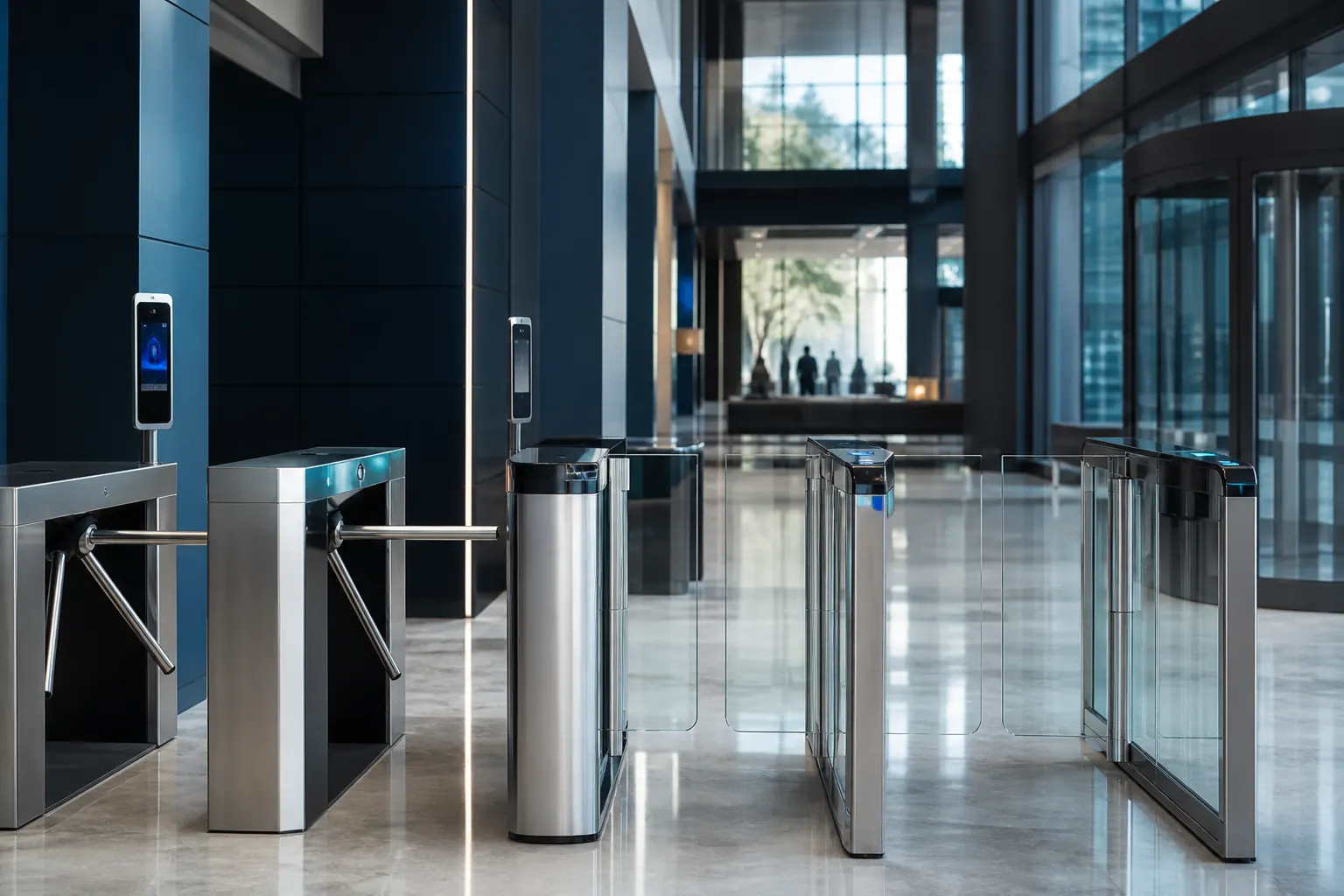
What a turnstile controls
A turnstile permits movement after receiving a valid command from a card, biometric, QR or ticket system. Identity decisions are made by the connected reader and software; the turnstile manages the physical passage.
Tripod, speed gate or full height
Tripod models suit many staff and visitor entrances, while speed gates provide a more open lobby appearance. Full-height turnstiles are used where perimeter control is stronger, subject to the site's safety and accessibility plan.
Layout and accessibility
Passage capacity, approach lines and reader position affect comfortable flow. An accessible gate and a route for large items should be planned alongside the turnstiles rather than treated as an afterthought.
Access and attendance integration
Compatible readers and controllers can apply user permissions in each direction. Attendance, visitor or catering links depend on supported protocols and data formats and should be confirmed with the relevant software.
Installation and service
A sound floor, protected cabling and sufficient lane width are required for secure installation. Maintenance covers locking mechanisms, arms or wings, sensors, controllers and the configured free-passage or emergency behavior.
Send dimensions and photographs for Turnstile Systems
Share the site, opening dimensions and expected use so we can clarify suitable equipment and installation scope.
Frequently asked questions
What to know about Turnstile Systems
How does a card-controlled turnstile work?+
The access controller validates the card and sends a one-passage command in the permitted direction.
When is a full-height turnstile appropriate?+
It suits controlled perimeter entrances where bypass resistance is important and the overall escape plan allows it.
Can turnstiles connect to attendance software?+
They can when the controller and attendance platform support a suitable data exchange.
What happens in an emergency?+
Release behavior depends on the model and site design and must be coordinated with the building's emergency requirements.